
Bats vary greatly in size. The smallest bat, Craseonycteris thonglongyai (Microchiroptera), weighs less than 2 g and has a wingspan of 12-13 cm, while the largest bats, those of the genus Pteropus (Megachiroptera), weigh up to 1.5 kg and may have a wing span over 2m (Fenton, 1992).
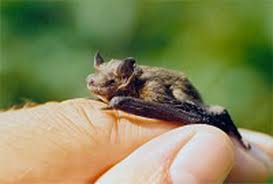
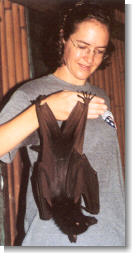
When we look at the differences between the Megachiroptera and the Microchiroptera we can see that that are more differences than just size:| Megachiroptera | Microchiroptera |
|---|---|
| don’t hibernate | many hibernate |
| complex visual system | less complex visual system |
| only 1 species uses sonar (in the form of tongue clicks) | use sonar (laryngeal sound) |
| no tragus | tragus |
| no facial ornamentation | facial ornamentation |
| claw on 2nd digit in most | no claw on 2nd digit |
| unmodified cervical vertebrae, ventral head posture | modified cervical vertebrae, dorsal head posture (enables them to bend their necks backwards, so that they can hang straight down in a roost and arch their heads back to look around) |
| no tail/uropatagium (usually) | tail and uropatagium (usually) |
| large body/eyes | small body/eyes |
| short or absent angular process on dentary | long narrow angular process on dentary |
| well-developed post orbital process | post orbital process generally absent |
| palate extends beyond last upper molar | Palate not extending past last upper molar |
| low, quadritubercular flat molars without W-shape specialised for crushing fruit | Sharp, W-shaped cusp that can shear and crush food |
Check out the Visual dictionary: Bat Morphology for a more visual aid to localise all these bodyparts.
The following is the complete classification of bats:
Order Chiroptera
  Megachiropteramorpha (unranked name)
    Suborder Megachiroptera
      Family Pteropodidae
  Microchiropteramorpha (unranked name)
     †Family Icaronycteridae
     †Family Archaeonycteridae
     Microchiropteraformes (unranked name)
       †Family Palaeochiropterygidae
       †Family Hassianycteridae
       Suborder Microchiroptera
         Superfamily Emballonuroidea
           Family Emballonuridae
             Subfamily Taphozoinae
             Subfamily Emballonurinae
       Infraorder Yinochiroptera
         Superfamily Rhinopomatoidea
           Family Craseonycteridae
           Family Rhinopomatidae
         Superfamily Rhinolophoidea
           Family Nycteridae
           Family Megadermatidae
           Family Rhinolophidae
             Subfamily Rhinolophinae
             Subfamily Hipposiderinae
         Infraorder Yangochiroptera
           Superfamily Noctilionoidea
             Family Mystacinidae
             Family Phyllostomidae
             Family Mormoopidae
             Family Noctilionidae
           Superfamily Nataloidea
             Family Myzopodidae
             Family Furipteridae
             Family Thyropteridae
             Family Natalidae
           Superfamily Molossoidea
             Family Antrozoidae
             Family Molossidae
               Subfamily Tomopeatinae
               Subfamily Molossinae
           Superfamily Vespertilionoidea
             Family Vespertilionidae
               Subfamily Vespertilioninae
               Subfamily Miniopterinae
               Subfamily Myotinae
               Subfamily Murininae
               Subfamily Kerivoulinae
(† extinct)
References
- Kirsch, J. A., J. M. Hutcheon, D.C. Byrnes &;B. D. Llyod. 1998. Affinites and historical zoogeography of the New Zealand Short-tailed bat, Mystacina tuberculata Gray 1843, inferred from DNA-hybridization comparisons. Journal of Mammalian Evolution 5(1): 33-64.
- Simmons, N. B. & J. H. Geisler. 1998. Phylogenetic relationships of Icaronycteris, Archeonycteris, Hassianycteris, and Palaeochiropteryx to extant bat lineages,with comments in microchiroptera. Bulletin of the American Museum of Natural History, 235:1-182.
Source: Tree of Life project